The world of automobiles is changing fast. Modern vehicles now use more electronic control units (ECUs) than ever before. Testing each system safely and quickly is a big challenge for every manufacturer. This is where Ettikengineering steps in with advanced HIL system in Pune solutions that make vehicle testing faster, safer, and more reliable.
Talk to our engineers for a custom HIL solution today
| Quick Facts: Automotive Testing Market 2026 Global automotive testing market size: USD 30 Billion (expected by 2026, CAGR ~5.2%)HIL testing segment share: ≈ 12–15 % of total validation systemsIndia’s automotive R&D spend growth: +18 % YoY (2025)Pune’s automotive cluster hosts 70 + testing labs & OEM R&D centers |
HIL System & Its Importance
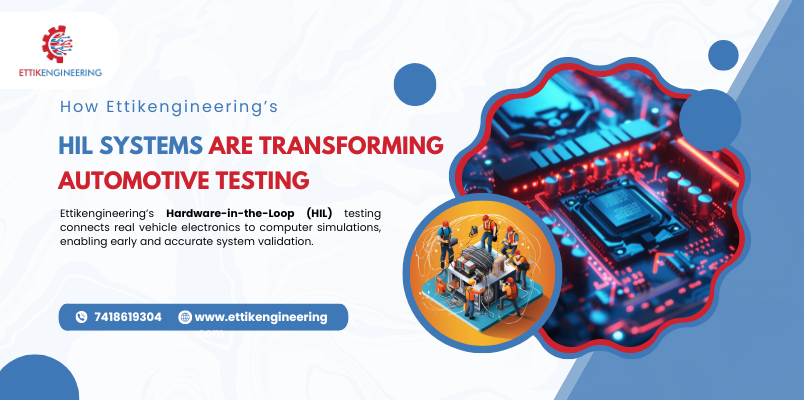
HIL stands for Hardware-in-the-Loop. It is a special setup where real electronic parts of a vehicle are connected to a computer that simulates the rest of the car. Instead of waiting for a full vehicle prototype, engineers can test the ECU’s response using a virtual model.
This method, known as Hardware in the loop testing in Pune, allows car makers to check hundreds of driving situations in a controlled lab. It helps them find problems early and improve product quality before the vehicle hits the road.
Did You Know?
A single HIL system can simulate over 500 real-world driving scenarios per hour, from heavy rain to highway lane changes — all inside a lab.
That’s why every major EV brand now invests in Hardware in the loop testing in Pune for faster validation.
Why Traditional Testing Is Not Enough
In old-style testing, teams needed physical prototypes and long road trials. It was slow, costly, and sometimes unsafe. With today’s electric vehicles and driver-assist systems, there are thousands of possible faults to test. Manual testing can’t keep up with that speed.
That’s why Hardware loop testing in Pune is now becoming a must for every research and development center. It gives repeatable results, reduces testing time, and ensures that every ECU behaves correctly under all road conditions.
| Feature | Traditional Road Testing | HIL Testing |
| Time to validate ECU | 6 – 8 weeks | 2 – 3 weeks |
| Cost per test cycle | ₹1 L – ₹2 L | ₹40 K – ₹60 K |
| Safety | Limited | Fully controlled |
| Repeatability | Low | 100 % automated |
How Ettikengineering Makes a Difference
Ettikengineering’s HIL system in Pune stands out because it combines powerful simulation software with strong real-time hardware. Each system is designed by expert engineers who understand both electronics and vehicle dynamics.
Some key benefits include:
- Real-time simulation: Recreates real driving conditions without using a full car.
- Automated test runs: The system can run hundreds of tests overnight without human help.
- Safety validation: Checks how brakes, steering, and battery systems behave in fault cases.
- Custom design: Built to match every client’s ECU type and communication protocol.
This advanced approach to Hardware in the loop testing in Pune helps automotive companies reduce development time by nearly 40 percent. It also improves accuracy and ensures each ECU meets global quality standards like ISO 26262.
| About Ettikengineering Founded in 2010, Ettikengineering is India’s trusted provider of automated test systems including HIL, DAQ, and EOL benches. Our engineers in Pune have delivered 50 + custom HIL solutions for top automotive and aerospace clients. |
See our full range of automated test systems here.
A Reliable Partner for Future Mobility
Many leading automotive brands now trust Ettikengineering for their testing automation needs. With local support, strong technical knowledge, and quick delivery, the company continues to set a high benchmark in Hardware loop testing in Pune and across India.
If you are an automotive manufacturer or R&D center looking to improve safety and performance, Ettikengineering is ready to help.
Connect with Ettikengineering on our Website, get Directions, or follow us on Instagram,
Glossary:
- HIL (Hardware-in-the-Loop): A mix of real ECUs + simulation.
- ECU: Electronic Control Unit — controls brakes, engines, and sensors.
- Test Bench: A setup used for testing ECUs safely.