End-of-Line (EoL) Testing for Automotive Manufacturing: A Complete Guide to Automated Test Equipment Solutions
A comprehensive guide to final production-line quality verification for automotive electronics and components, powered by industry-leading Automated Test Equipment Solutions.
No automotive component reaches a vehicle without first proving itself. An ECU, a wiring harness, a sensor module, a motor controller – each must pass a final quality checkpoint before it leaves the factory floor. That checkpoint is known as End-of-Line (EoL) testing, and it stands among the most consequential stages of automotive manufacturing quality control. Reliable Automated Test Equipment Solutions transform this checkpoint into a fast, accurate, and fully traceable process, giving manufacturers confidence in every unit that leaves the line.
This guide examines what EoL testing involves, why manufacturers depend on it, what a well-engineered EoL test system looks like in practice, and how Automated Test Equipment Solutions from Ettikengineering enable manufacturers to select the right engineering partner for the task.
What Is End-of-Line Testing?
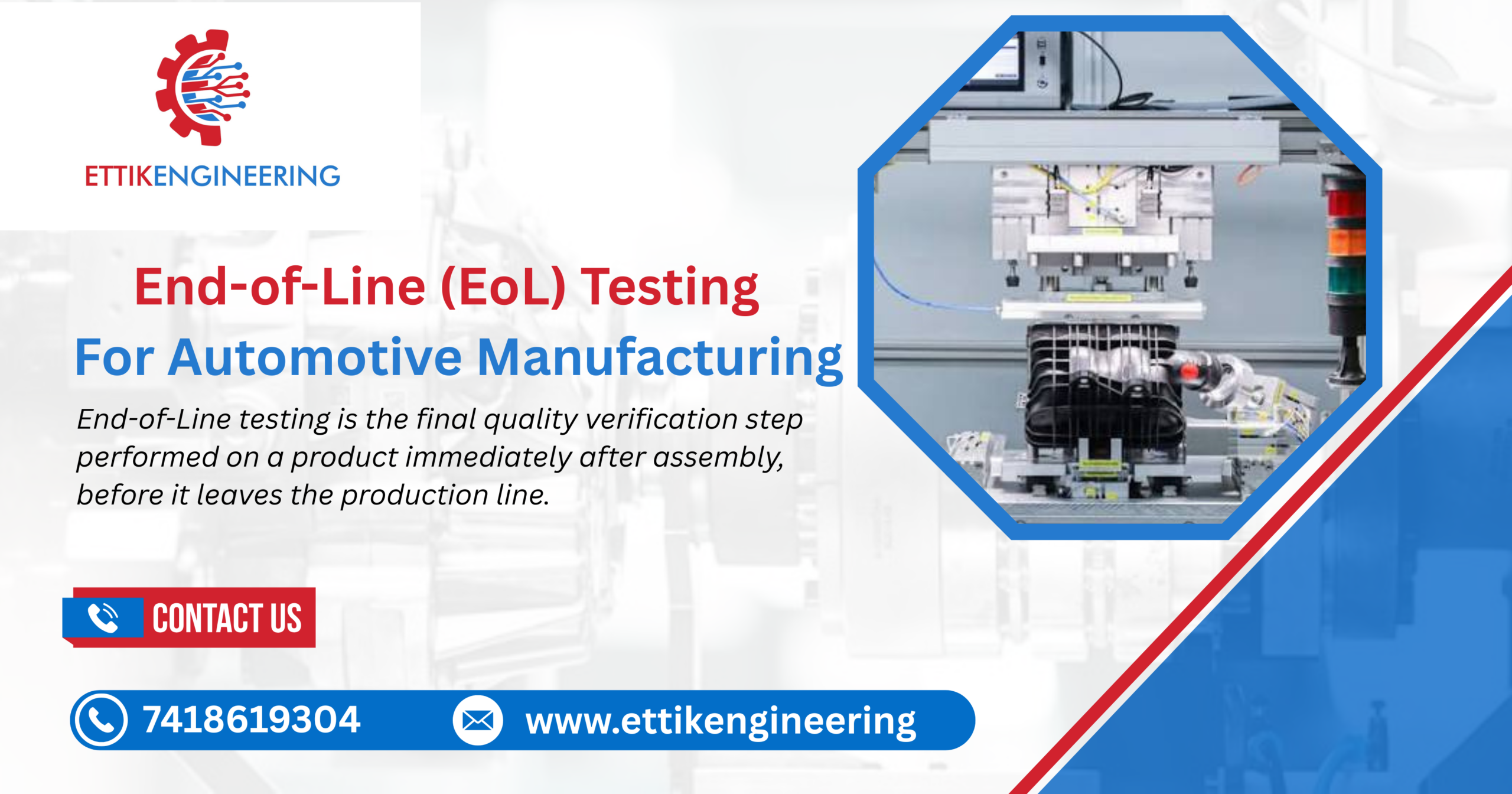
End-of-Line testing is the final quality verification performed on a product immediately after assembly, before it leaves the production line. Rather than testing components in isolation on a lab bench, EoL testing takes place directly on the manufacturing floor. Every unit – not merely a sample – is checked against clearly defined pass/fail criteria using purpose-built automated test equipment, ensuring consistent, repeatable quality assurance at production scale.
For automotive electronics, this typically involves verifying:
-
- Power-up behavior and voltage tolerances
-
-
- Communication bus functionality (CAN, LIN, FlexRay)
-
- Digital and analogue I/O responses
-
- Firmware version and configuration
-
- Mechanical fit and connector integrity
-
- Functional safety responses under simulated fault conditions
If a unit fails any check, it is flagged and removed from the line before it can be installed into a vehicle.
Every result is logged against the unit’s serial number for full traceability.
Visualizing the EoL Test Flow
The diagram below illustrates how a unit moves through a typical End-of-Line test station, from arrival to final disposition, supported end-to-end by Automated Test Equipment Solutions.
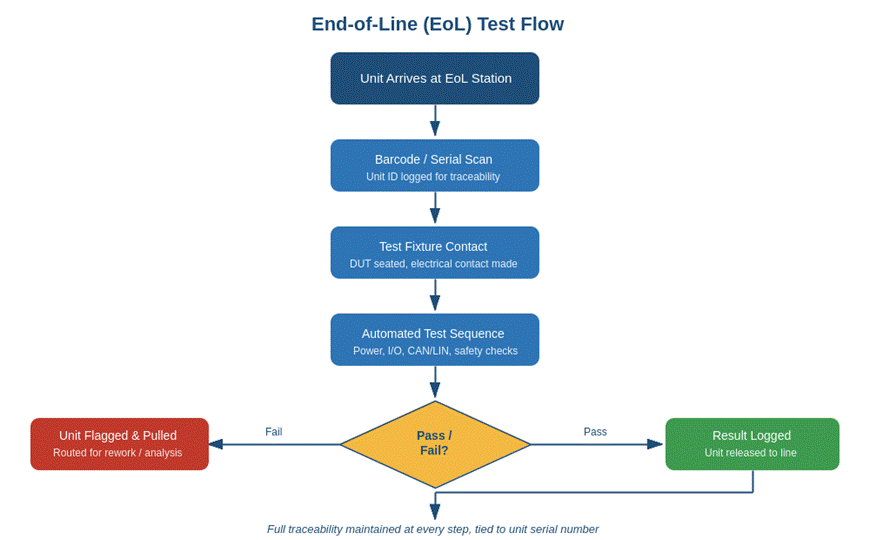
Figure 1: A unit’s path through an End-of-Line test station built with Automated Test Equipment Solutions.
Why EoL Testing and Automated Test Equipment Solutions Matter in Automotive Manufacturing
1. Catching Defects Before They Leave the Factory
Unlike sample-based quality checks, EoL testing verifies every unit produced. This is essential in automotive manufacturing, where a single faulty ECU or wiring harness can result in costly recalls or, in more serious cases, safety incidents in the field. Robust Automated Test Equipment Solutions ensure that no defective unit slips through undetected.
2. Protecting Production Throughput
A well-designed EoL test station is engineered for speed. Tests typically complete in seconds rather than minutes, so quality verification never becomes a bottleneck on a high-volume production line.
3. Supporting Traceability and Compliance
Automotive manufacturers operate under rigorous quality standards, including IATF 16949 and comparable frameworks. EoL test systems record every result against a unit’s serial number, providing manufacturers with a complete audit trail for compliance and warranty analysis.
4. Reducing Warranty and Recall Costs
Identifying a defect on the production line costs a fraction of what it costs to address after a vehicle has shipped. Backed by dependable Automated Test Equipment Solutions, EoL testing remains one of the most cost-effective quality gates in the entire manufacturing process.
Core Components of an EoL Test System
A typical automotive EoL test station, built on modern Automated Test Equipment Solutions, comprises the following elements:
| Component | Role |
| Test Fixtures | Hold the Device Under Test and make reliable electrical contact |
| Breakout Boxes (BOB) | Access and monitor every pin on the DUT during the test cycle |
| I/O Simulators | Generate the sensor and actuator signals the DUT expects in a real vehicle |
| Power Supplies & Load Boxes | Verify behavior across the DUT’s full operating voltage and load range |
| Test Software | Sequence steps, apply pass/fail logic, log results against each serial number |
| Barcode/Serial Scanners | Tie every test result back to a specific unit for full traceability |
Because every product line involves a distinct connector, pinout, and set of test requirements, EoL systems are rarely off-the-shelf solutions. Instead, they must be custom-engineered around the specific device under test (DUT).
Common Applications of EoL Testing
-
- ECU and VCU functional verification on the production line
-
-
- Wiring harness continuity and insulation testing
-
- Sensor and actuator module verification
-
- Motor controller and inverter testing for EV production
-
- Final functional checks prior to vehicle-level integration
Choosing the Right Automated Test Equipment Solutions Partner
Not every EoL system is engineered to the same standard. When evaluating a partner, look for the ability to:
-
- Design custom test fixtures and breakout boxes matched to your exact product pinout
-
-
- Build I/O simulation and load boxes tuned to your DUT’s real operating conditions
-
- Integrate test software with existing MES or traceability systems
-
- Deliver fast cycle times that keep pace with your production line
-
- Provide ongoing calibration, support, and system upgrades as your product evolves
How Ettikengineering Delivers Automated Test Equipment Solutions for EoL Testing
At Ettikengineering, we design and build custom Automated Test Equipment Solutions – Automated Test Equipment (ATE) for End-of-Line testing in automotive and EV manufacturing – including test fixtures, breakout boxes, I/O simulators, and EMI/EMC load boxes tailored to each customer’s exact DUT requirements. Our systems help manufacturers catch defects on the line, maintain full traceability, and keep production moving without compromising on quality.
Whether you are commissioning a new EoL station or upgrading an existing production test line, the Ettikengineering engineering team works closely with you to design Automated Test Equipment Solutions that fit your exact product and throughput requirements.
To discuss your EoL testing needs, contact our engineering team at sales@ettikengineering.com or +91 7418619304, or visit ettikengineering.com/ourproducts to explore our full range of Automated Test Equipment Solutions and test systems.
Ettikengineering specializes in embedded engineering, Automated Test Equipment Solutions, and custom electronics for the automotive and EV sectors across India, with dedicated engineering teams serving Bangalore and Pune.
Frequently Asked Questions About Automated Test Equipment Solutions
What are Automated Test Equipment Solutions?
Automated Test Equipment Solutions refer to engineered hardware and software systems – such as test fixtures, breakout boxes, I/O simulators, and test software – that automatically verify a product’s functionality, safety, and quality at speed and scale on a production line.
Why do automotive manufacturers need Automated Test Equipment Solutions for EoL testing?
Automated Test Equipment Solutions allow manufacturers to test every unit produced within seconds, ensuring defective ECUs, harnesses, or sensors never reach a vehicle, while maintaining full serial-number traceability for regulatory compliance.
Who provides Automated Test Equipment Solutions for EV and automotive manufacturing?
Ettikengineering provides custom Automated Test Equipment Solutions for automotive and EV manufacturers, including EoL test fixtures, breakout boxes, and I/O simulators. Learn more at https://ettikengineering.com/.
: A Complete Guide to Automated Test Equipment Solutions
A comprehensive guide to final production-line quality verification for automotive electronics and components, powered by industry-leading Automated Test Equipment Solutions.
No automotive component reaches a vehicle without first proving itself. An ECU, a wiring harness, a sensor module, a motor controller – each must pass a final quality checkpoint before it leaves the factory floor. That checkpoint is known as End-of-Line (EoL) testing, and it stands among the most consequential stages of automotive manufacturing quality control. Reliable Automated Test Equipment Solutions transform this checkpoint into a fast, accurate, and fully traceable process, giving manufacturers confidence in every unit that leaves the line.
This guide examines what EoL testing involves, why manufacturers depend on it, what a well-engineered EoL test system looks like in practice, and how Automated Test Equipment Solutions from Ettikengineering enable manufacturers to select the right engineering partner for the task.